
Q2’26 Commentary
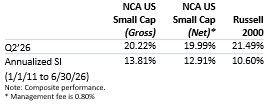
Small caps made a big comeback in Q2. US equity investors rotated out of concentrated mega-cap tech companies and into small caps, with the Russell 2000 returning 21.49% in the quarter, while the Mag 7 and large-cap Russell 1000 lagged, returning 10.98% and 15.13%, respectively.
Seeking higher relative earnings growth, US equity investors looked to small caps. The Russell 2000 is projected to deliver over 40% EPS growth year-over-year, dwarfing the S&P 500’s mid-teens forecast. Small cap’s higher growth reflects a multi-year, capex super-cycle in the US. Driven by industrial reshoring, AI supply chain expansion, data center buildouts and infrastructure investments, this domestic spending boom favors the localized footprint of small cap companies.
The NCA US Small Cap strategy’s overweight in Industrials exposes it to these domestic growth drivers and its projected long-term earnings growth of 19.3% far outpaces the Russell 2000 growth of 8.4%. The strategy is a concentrated portfolio of 25 to 45 holdings that we believe isn’t built to simply ride the small-cap rotation, but beat it.
Small caps may also offer investors a larger margin of safety. Entering Q2, the S&P 500 was almost priced for perfection, trading at roughly 23x forward earnings, more than a full standard deviation above its 10-year median. Conversely, the high quality small-cap S&P 600 Index traded at about 16.0x, slightly below its long-term median. The NCA Small Cap strategy capitalizes on this dislocation through our strict valuation discipline. Driven by rigorous, bottom-up fundamental analysis, we strive to build a portfolio of high quality companies trading at a discount.
Lastly, a distinct flight to quality in small caps is underway. In June, the quality S&P 600 returned 7.29%, nearly double the return of the lower quality Russell 2000. Year-to-date through June 30th, the S&P 600 is beating the Russell 2000, returning 23.98% vs. 22.69%. As the market cycle matures and the quality premium inevitably expands, our strict mandate to own high quality companies should position the portfolio for sustained outperformance.
Ibbotson research notes that when the small-cap rotation begins, the capital reallocation plays out over many years. Based on data from 1930, the shortest small-cap leadership cycle lasted 10 years while the longest lasted 15 years. The macro rotation into small caps provides the tailwind, but we believe our concentrated portfolio of high conviction, high quality holdings offers investors sustained outperformance through superior earnings growth and multiple expansion over the long term.
Quarterly Performance
Portfolio Attribution Analysis
In Q2 the small-cap Russell 2000 Index returned 21.49%. The best performing sector was IT, returning 56.17%, driven by the Semiconductors and Semiconductor Equipment sub-sectors, which returned a remarkable 104.38% in the quarter. Healthcare was the next best performing sector at 24.55%, led by the Pharma, Biotech and Life Sciences sub-sector, which returned 25.54%. The worst performing sector was Energy, returning -10.06%, due to the temporary ceasefire between the US and Iran.
The high quality NCA strategy managed to keep up, in a quarter that was led by lower quality companies in the benchmark. On a gross basis, the strategy delivered 94.1% upside capture. Sector allocation was the main cause for the lag, detracting a net -99 bps. The overweight in Energy and Consumer Staples, and underweight in IT were the main sector detractors. The underweight in Consumer Discretionary and Financials, and overweight in Industrials were the main sector contributors.
Stock selection detracted a net -9 bps. The largest detractor was Primoris (PRIM), an energy infrastructure firm that missed earnings and lowered guidance due to cost overruns on six solar installation projects. However, our investment thesis remains intact. Management took swift corrective action with the departure of the head of renewables and COO, and the company’s core segments continue to deliver. Another detractor, Shake Shack (SHAK), declined on disappointing earnings and lowered guidance. Despite incremental store-level operational improvements, competition remains intense. Although unit expansion and premium offerings should drive a top-line recovery, we expect the stock to remain range-bound for the foreseeable future and we exited the position. The largest contributor in Q2 was Amkor Technology (AMKR), the only US-based provider of outsourced semiconductor assembly and test (OSAT) services. It is capturing critical advanced packaging demand and AMKR also cemented its role in domestic chip reshoring by announcing a 10-year partnership to service Taiwan Semiconductor’s new Arizona facility. The portfolio was fully invested with cash averaging 1.82%.
Important Disclosures:
PAST PERFORMANCE IS NOT AN INDICATOR OF FUTURE RESULTS. An investor should carefully consider the Strategy’s investment objective, risks, charges and expenses before investing. One cannot invest directly in an index. There is no guarantee that the investment objective of the strategy will be achieved. Index returns reflect the reinvestment of income dividends and capital gains, if any, but do not reflect fees, brokerage commissions or other expenses of investing. Period data over one year is annualized. You should not rely on this document as the basis upon which to make an investment decision. The Strategy’s return may not match the return of the underlying index. Investing involves risk, including possible total loss of principal.
The principal risks of investing in this strategy include: Equity securities risk, Sector Risk, Non-diversification Risk, Effects of Compounding and Market Volatility Risk, Market Risk, Counterparty Risk, and Rebalancing Risk, which can increase volatility. The Strategy may invest in derivatives, which are often more volatile than other investments and may magnify the Strategy’s gains or losses.
The performance returns contained the deduction of advisory fees, which will reduce the return. The deduction of advisory fees and the compounding effect thereof over time will reduce the total return on any account. For example, an account of $10 million with a 1% fee that experienced a 10% compounding annualized total return over a period of five years would result in an ending dollar value of $16,105,100 without the deduction of advisory fees. If an annual advisory fee of 1% were deducted from the account for the same five-year period, the annualized return would be 9%, with an ending dollar value of $15,315,789. Additional information regarding policies for calculation and reporting returns is available upon request. Additional fees may apply, including brokerage and custodian fees, settlement fees, interest charges, wire fees, transfer fees and fund expenses, incurred in connection with the management of a client’s account.
A FEE SCHEDULE IS AN INTEGRAL PART OF A COMPLETE PRESENTATION AND IS DESCRIBED IN PART II OF THE FIRM’S ADV, WHICH IS AVAILABLE UPON REQUEST. RETURNS INCLUDE THE REINVESTMENT OF DIVIDENDS AND OTHER EARNINGS, WHERE APPLICABLE.
Certain performance calculations are prepared internally and have not been audited or verified by a third party. The use of a different methodology for preparing, calculating or presenting performance returns and portfolio characteristic data may lead to different results and such differences may be material. “Representative Account(s)” discussed were selected based on a number of factors including, length of time in the composite and investment guideline applicability.
HOLDINGS AND SECTOR WEIGHTINGS – Sector and Holdings are subject to change and are not buy/sell recommendations. An investor should consider their objectives, financial situation or needs and risk profile before making any investment decision.
The information contained in this document may not be reproduced or provided to others without the prior written permission of New Century Advisors, LLC. The information provided is neither an offering nor a solicitation of an offering for any securities.
Prior to June 2023 the US Small Cap Strategy was known as the US SMID Cap Strategy and the prior benchmark was the Russell 2500. The benchmark was changed to reflect the portfolio characteristics.